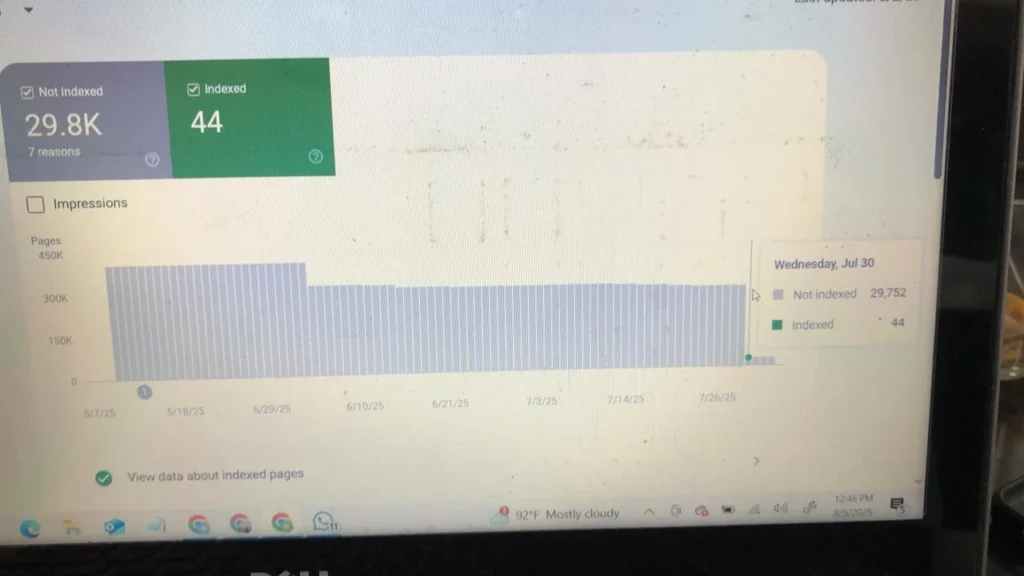
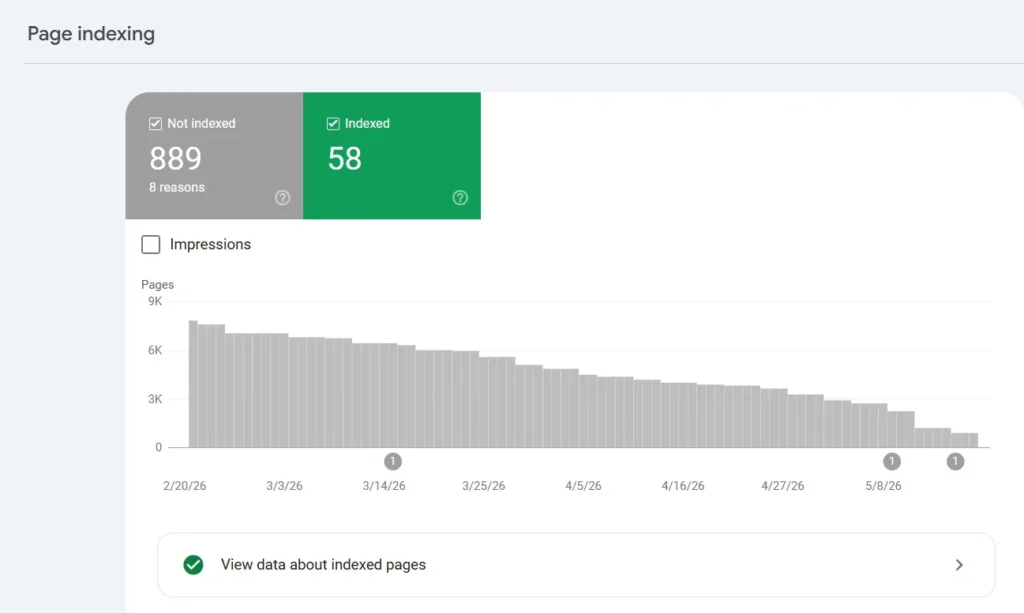
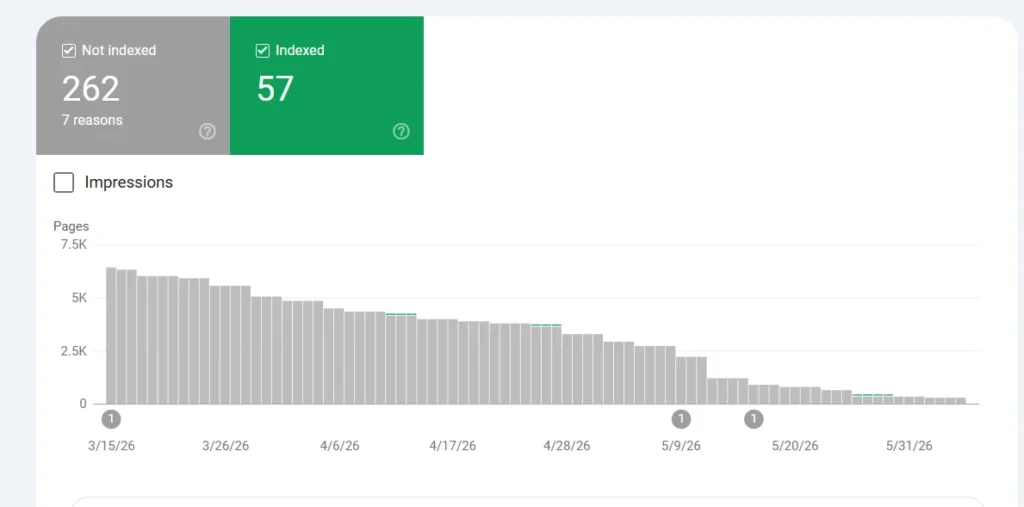
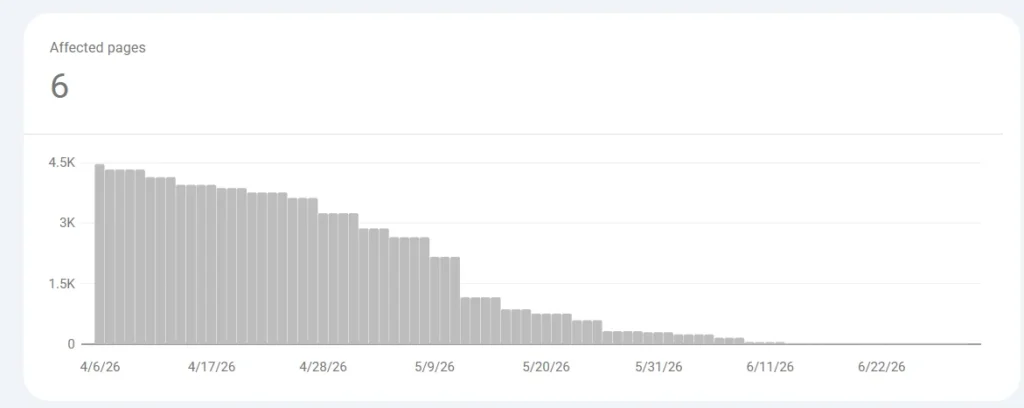
Executive Summary: As an independent SEO consultant delivering specialized execution, few technical disasters induce panic quite like watching a client’s total indexed pages spike overnight. This work proof documents the 12-month technical cleanup of a massive programmatic injection attack that inflated Google Search Console (GSC) index bloat to 350,000+ spammy numeric links.
When an enterprise domain gets hit with a programmatic query parameter or database exploitation, malicious actors generate dynamic thin-content URLs (e.g., /index.php?id=837283472 or /page/983742/). Left unchecked, this degrades server health, completely consumes daily crawl capacity, and freezes high-value commercial search rankings.
1. The Anatomy of the Attack: Database Exploitation
The vulnerability stemmed from an unvalidated input dynamic parameter on legacy server configurations. Scraper bots systematically bombarded search query scripts, forcing the server’s backend database to generate dynamically rendered web pages on the fly.
Because the application returned a standard HTTP 200 OK status code instead of a 404 error, Googlebot treated every single numeric variant as a valid unique page. Within weeks, Google mapped hundreds of thousands of ghost URLs, leading to severe technical consequences that required full-scale spam recovery and index stabilization.
2. The Technical Impact: Crawl Budget Destruction & Index Bloat
Search engines do not dedicate infinite resource capabilities to a single host. Google assigns a strict Crawl Budget determined by server bandwidth, speed, and domain authority.
[Googlebot Daily Crawl Capacity]│
├─► 95% Wasted on: 350,000+ Dynamic Spam URLs (HTTP 200 OK)
│
└─► 5% Preserved for: Core Commercial Services & Lead Conversion Funnels
This massive influx of unwanted links crippled site health in three distinct ways:
- Commercial Page Neglect: Googlebot spent over 90% of its daily crawl allowance fetching randomized query strings. Actual money-making pages fell out of the re-crawl queue.
- Canonicalization Breakdowns: Massive index bloat confused canonical mapping rules, pushing core landing assets into Google’s “Crawled – currently not indexed” state.
- Server Resource Exhaustion: Dynamic generation of thousands of spam requests drove up CPU usage, slowing down Time to First Byte (TTFB). This directly impacted our overall on-page optimization metrics and Core Web Vitals performance.
3. Google Search Console Diagnostic Barriers
Isolating patterns in Google Search Console presented significant operational hurdles. GSC UI exports strictly cap data displays at 1,000 rows, while the official Search Console API limits standard bulk reporting to 50,000 rows per day.
When dealing with over 350,000 bad links, standard CSV downloads are insufficient. To overcome this limitation:
- We extracted raw server access logs (Nginx/Apache files) using command-line tools (
Grep / Awk) to capture exact numeric string patterns directly from server memory. - We utilized advanced Regular Expressions (Regex) inside GSC’s inspection filters (e.g.,
\?id=[0-9]+$) to isolate affected paths without running into export limits.
4. The 12-Month Chronological Remediation Plan
Flushing a domain’s index must be handled carefully. Implementing hasty sitewide redirects or blocking infected parameters in robots.txt can lock spam pages permanently in the index because Googlebot gets barred from crawling their removal status.
| Phase | Timeline | Technical Objective & Action Taken |
|---|
| Phase 1 | Months 1–2 | Fixed dynamic database injection scripts; isolated numeric parameter patterns using server log parser scripts. |
| Phase 2 | Months 3–5 | Configured server rewrite rules returning HTTP 410 Gone response headers instead of standard 404s. |
| Phase 3 | Months 6–8 | Uploaded temporary sitemaps containing bad links to force immediate Googlebot re-crawling. |
| Phase 4 | Months 9–10 | Tracked log file activity to confirm crawl budget rebalancing toward primary commercial nodes. |
| Phase 5 | Months 11–12 | Validated full index recovery inside GSC, bringing total spam link counts down to zero. |
Phase Details & Technical Execution
HTTP 410 Header Implementation: Instead of simple 404 Not Found status codes, we configured Nginx rewrite conditions to explicitly return HTTP 410 Gone headers. This explicitly indicates to search engine crawlers that the deleted resource is permanently gone, prioritizing swift removal from Google’s index.
The XML Sitemap Injection Play: Waiting for Googlebot to discover millions of broken URLs organically can take years. We compiled temporary XML sitemaps filled with the target spam URLs and submitted them via Search Console. This forced Googlebot to systematically re-crawl these paths, trigger the 410 Gone status codes, and immediately clear them from the index.