How I Recovered Boxproof Packaging From a 59% Moz Spam Score in 5 Months

CLIENT

Invision Studio

SERVICES

Invision Studio

DURATION

Invision Studio

WEBSITE

Invision Studio

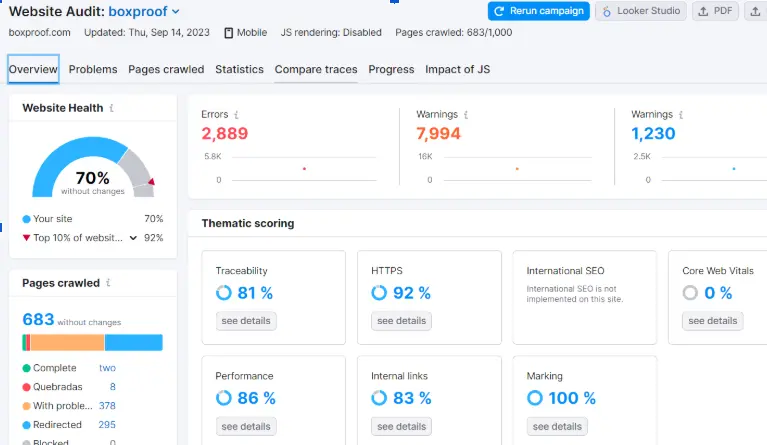
boxproof 1st semrush audit report 2000 plus errors on website

A Custom-Coded Site Drowning in Toxic Links

Boxproof Packaging came to me with a serious problem: their domain had accumulated a Moz spam score of 59% – dangerously close to the threshold where Google’s algorithms begin treating a site as a low-quality or manipulative domain. Organic traffic had stagnated despite the business being a legitimate, established packaging company.

The site was built on custom code (not WordPress), which ruled out most plug-and-play audit tools. The backlink profile had years of low-quality link building baked in – forum spam, link directories, unrelated niche sites, and a handful of genuinely toxic anchor clusters that were dragging the domain down.

The brief was clear: clean the domain, stop the traffic decline, and rebuild organic visibility – without rebuilding the site from scratch.

Programmatic Audit Against Moz's 24 Spam Rules

Full backlink export – pulled the complete backlink profile from Ahrefs and cross-referenced with Google Search Console link data to get a unified picture of every linking domain.
The site was built on custProgrammatic rule application – mapped every linking domain against Moz’s 24 Spam Score rules (link velocity, anchor ratio, domain age, TLD patterns, link neighborhood, etc.) to score each link cluster systematically rather than manually reviewing thousands of links one by one. om code (not WordPress), which ruled out most plug-and-play audit tools. The backlink profile had years of low-quality link building baked in – forum spam, link directories, unrelated niche sites, and a handful of genuinely toxic anchor clusters that were dragging the domain down.
Tiered classification – grouped links into three buckets: Keep (high-quality, relevant), Monitor (borderline, flag for quarterly review), Disavow (toxic, immediate action).
Disavow file creation – built a structured disavow file targeting domain-level disavows for the worst offenders and URL-level disavows for isolated toxic pages on otherwise acceptable domains.
On-page cleanup – alongside the link work, fixed internal link anchor text distributions, removed spammy footer links, and cleaned up keyword-stuffed metadata that was amplifying spam signals.
GSC monitoring – tracked spam score weekly via Moz and correlated with GSC performance data to confirm Google was recrawling and re-evaluating the cleaned domain.
Boxproof 5th SEMrush audit report-critical errors decreased to 3 errors

The Results

59% Spam Score to 1% - In Five Months

Within five months of the disavow file submission and ongoing cleanup, Boxproof’s Moz spam score dropped from 59% to 1% – effectively a clean domain. Organic traffic responded directly: the site recorded 300% growth in organic sessions over the same period, driven primarily by rankings recovery on core packaging keywords that had been suppressed during the high-spam-score period.

Most SEOs treat spam score as a vanity metric. This project proved it isn’t – a 59% spam score was actively suppressing a legitimate business. The programmatic approach (rules-based, systematic, auditable) is what made it possible to clean thousands of links in weeks rather than months. If your domain has a Moz spam score above 30%, it’s worth investigating before it becomes a recovery project.

Most SEOs treat spam score as a vanity metric. This project proved it isn’t – a 59% spam score was actively suppressing a legitimate business. The programmatic approach (rules-based, systematic, auditable) is what made it possible to clean thousands of links in weeks rather than months. If your domain has a Moz spam score above 30%, it’s worth investigating before it becomes a recovery project.

spam score before 59 percent and after 1 percent

Senior SEO Strategist & Growth Engineer · 6+ Years Experience

© 2026 Nawaz Search Lab. All Rights Reserved.